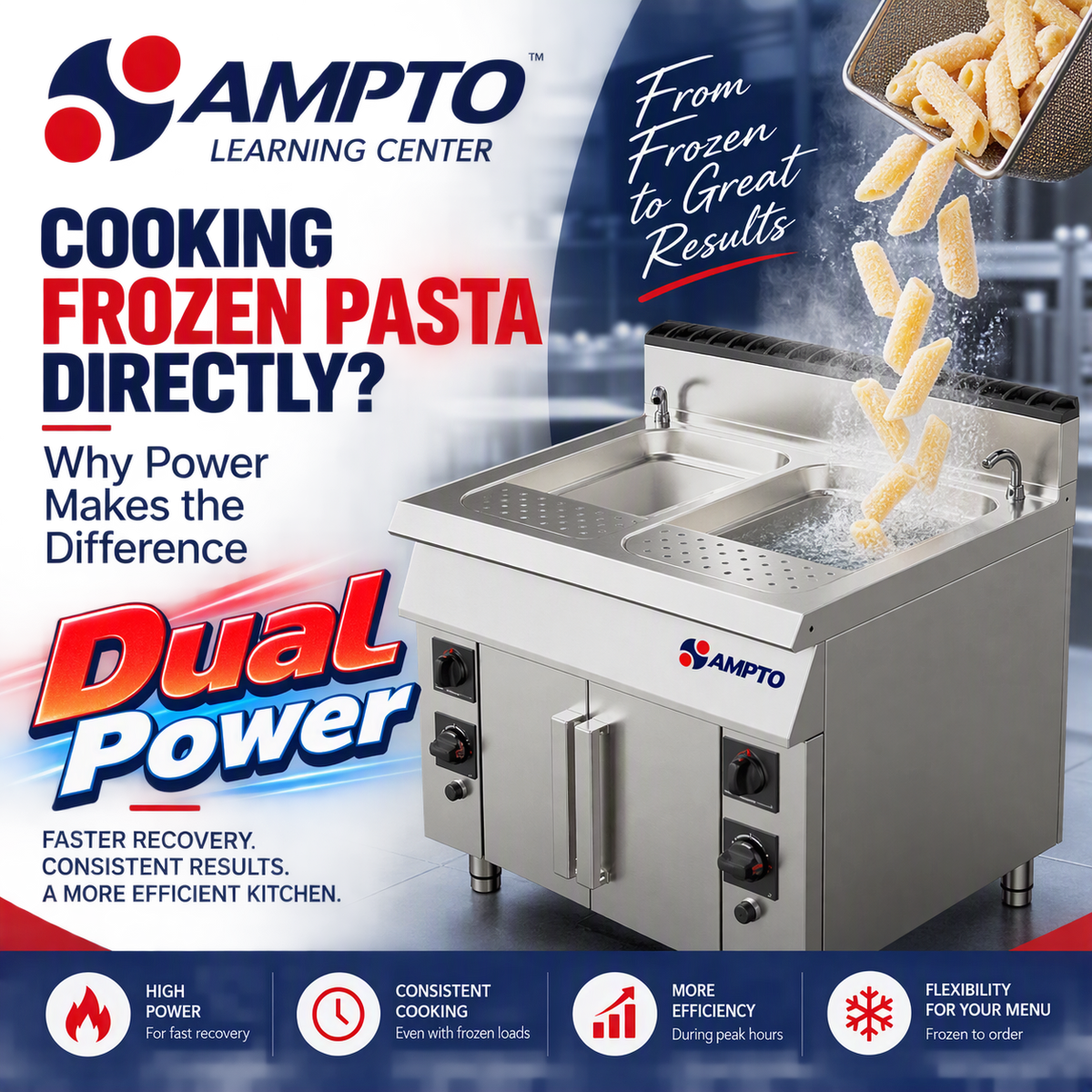
Cooking refrigerated pasta and cooking pasta directly from frozen place very different thermal demands on a commercial pasta cooker.
When frozen pasta is dropped into boiling water, it immediately absorbs a significant amount of heat. The water temperature falls, and if the pasta cooker does not have enough power and recovery capacity, the water may temporarily lose its boil.
AMPTO specifically addresses this challenge in its gas pasta cooker documentation, noting that frozen ingredients can cause a temperature drop that prevents the water from maintaining a boiling state and may affect cooking quality. AMPTO's dual-power burner design is intended to provide thermal stability and rapid recovery.
When cooking pasta from frozen, reaching the boil is only the beginning. What really matters is how quickly the pasta cooker can recover after each load.
The Thermal Challenge of Frozen Pasta
Consider what happens during a busy service:
- The water is boiling.
- A portion of frozen pasta enters the tank.
- The frozen product absorbs heat from the water.
- The water temperature drops.
- The heating system must deliver enough energy to restore the required cooking conditions.
- Another order may arrive shortly afterward, repeating the cycle.
In a low-volume environment, an occasional temperature drop may be manageable.
In a commercial kitchen producing load after load, however, thermal recovery becomes essential to maintaining consistent cooking conditions.
This is where the difference between simply boiling water and operating a professional pasta cooker becomes important.
Power Means Recovery
When selecting a pasta cooker for frozen products, looking only at tank capacity does not tell the full story.
A large tank may physically hold the required amount of pasta, but the heating system must also have enough power to respond to the thermal load created when frozen product enters the water.
The critical sequence is:
Frozen Pasta → Temperature Drop → Energy Demand → Thermal Recovery → Consistent Cooking Conditions
The more frequently frozen loads are introduced, the more important recovery capacity becomes.
The critical question is not simply:
"How much pasta can the tank hold?"
It is also:
"How quickly can the pasta cooker recover after I drop frozen pasta into the water?"
That is where power becomes a real production tool.
What Happens When Recovery Is Too Slow?
The challenge does not end with the first batch.
During peak service, several orders may arrive one after another.
If the first frozen load significantly reduces the water temperature and the pasta cooker is still recovering when another batch is introduced, the cooking conditions can change from one order to the next.
That makes one of the most important objectives in a professional kitchen more difficult to achieve:
consistency.
Selecting the proper pasta cooker therefore is not simply about choosing the highest power rating available. It is about choosing equipment with enough thermal capacity for the product, portion size, volume, and frequency of loads the kitchen actually needs to handle.
AMPTO Gas Pasta Cookers: Up to 160,000 BTU/h
AMPTO addresses thermal recovery directly with its professional gas pasta cookers.
The AMPTO 90CPG45 PLUS is a single-tank model with 80,000 BTU/h of thermal power.
For higher production requirements, the AMPTO 90CPG90 PLUS provides two tanks and a total thermal power of 160,000 BTU/h.
AMPTO identifies these models as dual-power burner, fast-recovery models.
That distinction becomes particularly important when working with frozen pasta.
The value of 80,000 or 160,000 BTU/h is not simply the ability to initially bring a tank of water to a boil.
The real test comes after the frozen product enters the water.
That is when the pasta cooker must respond to the energy that has just been removed from the tank.
AMPTO Electric Pasta Cookers: The Same Principle
Thermal recovery is equally important in an electric pasta cooker.
The AMPTO 90CPE45 provides 9 kW of thermal power, while AMPTO's double-tank electric configuration provides 18 kW. The specifications call for a 220V, three-phase electrical supply.
AMPTO's electric pasta cooker documentation also specifies dual-power external heating elements.
Gas and electric pasta cookers use different heat sources, but the operational objective is the same:
Replace the heat lost when frozen product enters the tank as effectively as possible.
For the operator, that means focusing on thermal recovery, not merely the energy source.
Why Does This Matter to the Business?
This is where a technical specification can influence the way a kitchen operates.
When the menu and product allow pasta to be cooked directly from frozen, a restaurant can consider keeping portions frozen until they are needed, following the appropriate food preparation, storage, and food-safety procedures.
This provides an alternative to relying exclusively on large quantities of precooked pasta prepared before service.
A traditional precooking workflow may involve:
Prepare → Precook → Cool → Store → Reheat/Finish → Serve
Depending on the product and operation, cooking from frozen may provide a more direct workflow:
Frozen Storage → Cook → Finish → Serve
Precooking remains a valid strategy for many restaurants and pasta types. Cooking from frozen is not automatically better for every operation.
However, when cooking directly from frozen is appropriate for the menu, the power of the pasta cooker becomes a key part of making that workflow practical during commercial service.
Frozen Storage Can Also Support Better Production Control
Working with properly portioned frozen products can help a kitchen better align production with actual demand.
Instead of precooking the entire anticipated volume before service, certain operations can maintain portions frozen and cook them as needed.
This can potentially help reduce exposure to overproduction and food waste while providing greater inventory flexibility.
But there is an important condition:
The pasta cooker must be capable of handling the thermal demand created by frozen products.
Without adequate power and recovery, the operational advantages of cooking from frozen can be undermined by inconsistent cooking conditions or slower production during peak periods.
Power + Recovery + Continuous Production
AMPTO combines thermal capacity with other features designed for professional pasta production.
AMPTO gas and electric pasta cookers include an automatic starch-removal system, multiple baskets, AISI 304 stainless steel construction, and stamped AISI 316 stainless steel tanks.
The pasta cookers also include six 1/6 baskets per tank, allowing operators to manage multiple individual loads within the cooking station.
For a kitchen cooking frozen portions to order, these features support a straightforward production concept:
Frozen Product + Individual Portions + Proper Power + Fast Recovery = A Pasta Station Built for Continuous Service
Don't Look Only at Tank Size When Choosing a Pasta Cooker
When evaluating a commercial pasta cooker, ask an important question:
Does this equipment have enough power to quickly recover its temperature when I introduce frozen pasta?
For an operation working with frozen product, that question can be just as important as tank size.
The power rating of a pasta cooker is not simply another number on a specification sheet.
It represents the equipment's ability to respond when the kitchen demands it most.
During peak service, when orders are coming in and frozen portions are repeatedly being introduced into the tank, BTUs and kilowatts stop being abstract specifications.
They become production capacity.
Choose the Right Power for Your Operation
AMPTO professional pasta cookers are available in gas and electric configurations, with single- and double-tank options to accommodate different production requirements.
AMPTO gas configurations discussed here provide 80,000 or 160,000 BTU/h, while the electric configurations provide 9 kW or 18 kW of thermal power.
AMPTO's specification sheets also state a 1-year parts and labor warranty in the United States for these pasta cookers.
If your operation cooks pasta directly from frozen, start with power.
AMPTO Professional Pasta Cookers. Power when your kitchen needs it most.