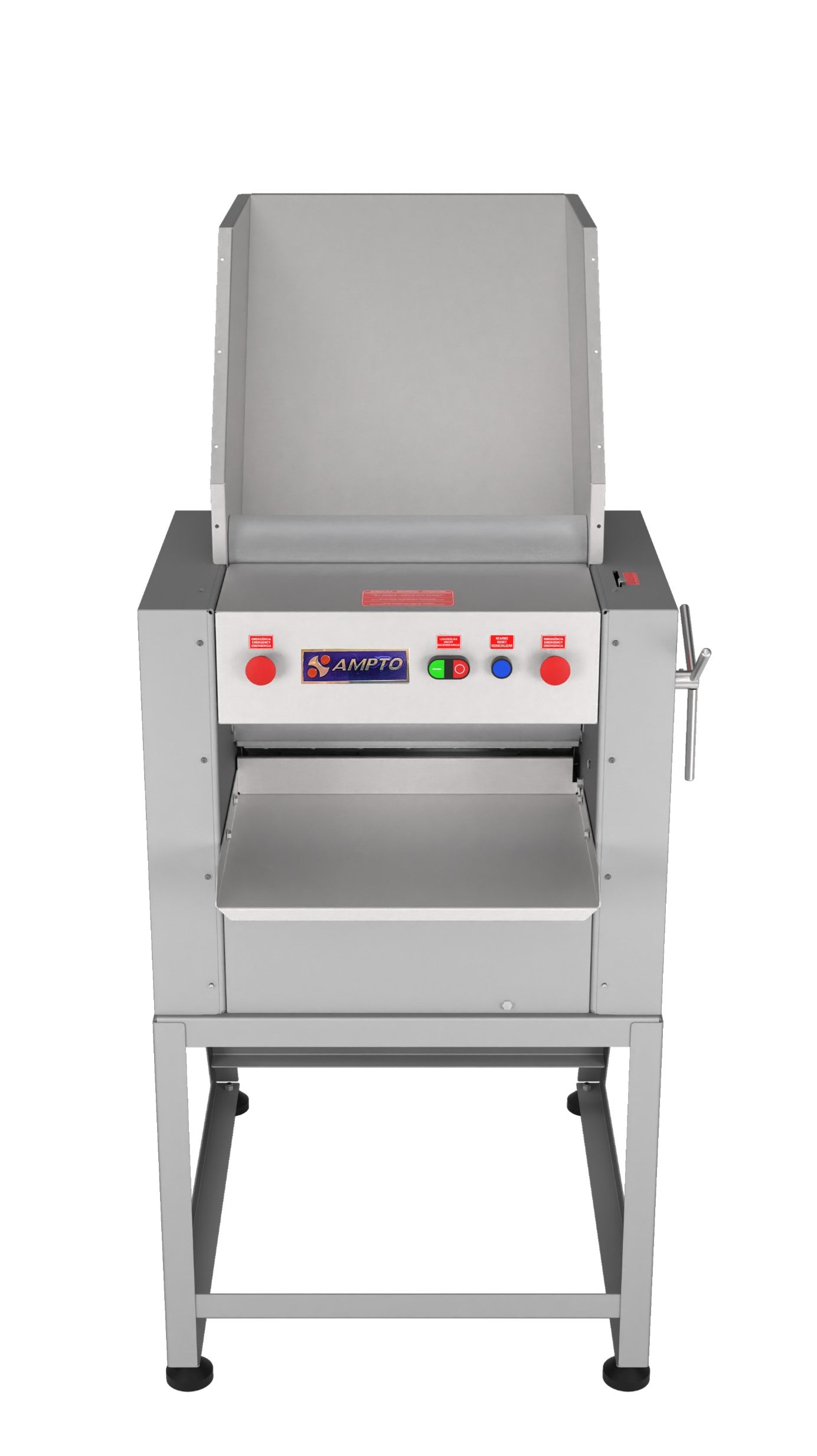
Dough sheeters and dough breakers are both dough-processing machines, but they serve different purposes in food production. A dough sheeter is designed to roll out dough into thin, uniform sheets. It uses adjustable rollers (often with a conveyor if space is available, otherwise a countertop version is a great solution) to flatten dough to a precise thickness, making it ideal for pastries, croissants, pie crusts, pizza dough, pasta sheets, and other applications requiring an even, thin dough layer. In contrast, a dough breaker is a heavy-duty kneading and rolling machine built to handle large, stiff dough batches. Sometimes called a “dough brake” or Sobadora, a dough breaker uses robust rollers (often driven by powerful motors) to compress, knead, and refine dense dough – for example, working big portions of bread dough that are too tough or heavy for a standard sheeter. Dough breakers excel at repeatedly rolling and folding firm or low-moisture doughs (often 30–50 lb at a time) to develop gluten and structure. However, unlike sheeters, breakers are not intended for producing very thin or delicate dough sheets; manufacturers warn that dough breakers are meant for kneading (e.g. bread dough) and should not be used for ultra-thin pastry or pasta dough.
In summary, the primary difference is in their function and output: a dough sheeter specializes in final dough sheet formation (achieving fine, consistent thickness), while a dough breaker focuses on initial dough development and bulk reduction. Bakeries would use a sheeter to get, say, a 2 mm-thick pastry sheet, whereas a breaker would be used to condition a large lump of dough into a manageable slab (left thicker) before further processing. Structurally, sheeters have precision gap settings (some with reversible conveyors) to gradually reduce thickness without overworking the dough. Breakers, by comparison, are built for power and capacity – featuring stronger frames, larger rollers, and safety features like chutes or tables to guide substantial dough loads through the machine. Both machines mechanize labor-intensive rolling, but a sheeter is the go-to for fine, even dough sheets, whereas a breaker is chosen for heavy kneading and pre-sheeting of tough or bulk dough.
|
Feature |
Dough Sheeter |
Dough Breaker |
|
Primary Function |
Rolls and presses dough into thin, uniform sheets. |
Kneads/compresses large, heavy dough batches with strong rollers. |
|
Typical Applications |
Pastry and baking: croissants, puff pastry layers, pie crusts, pizza bases, pasta sheets, tortillas, etc., where consistent thin dough is needed |
Bread and dense doughs: bread loaves, regional breads (e.g. Cuban, Haitian bread), and initial bulk dough refinement before dividing or shaping. Not used for delicate pastry sheets. |
|
Operation & Design |
Uses adjustable rollers (often with conveyors) for precise thickness control, allowing dough to be rolled down to a few millimeters (≈0.5–4 mm) thin. Typically handles one portion at a time, fed and retrieved manually or via belts. |
Uses heavy-duty rollers (sometimes multiple sets or dual motors) to exert high pressure on dough. Built with sturdy frames and safety guides (e.g. chutes/tables) for handling large 30–50 lb dough lumps at once. Requires multiple passes to gradually refine dough; not capable of ultra-thin sheeting |
|
Output Thickness |
Very thin, even sheets of dough (thickness adjustable to recipe, e.g. a few millimeters for pastry) – ready for final shaping, layering, or cutting. |
Thicker dough sheets or slabs suitable for further kneading or portioning. Primarily produces a well-kneaded, conditioned dough mass (not a finished thin sheet) due to its focus on heavy dough development |
|
Capacity per Batch |
Smaller portions of dough per pass (often a few pounds or individual dough pieces). Operators typically divide dough into pieces before sheeting. |
Large batches of dough (e.g. 30–50 lb) can be processed in one operation . Ideal for bulk dough handling and reducing a mass to a workable state in fewer steps. |
Each machine is thus tailored to a different stage and style of dough processing. In a professional bakery, dough sheeters are indispensable for fine pastry and uniform thin dough work, while dough breakers are valued for handling tough, high-volume dough kneading tasks that would be difficult by hand or with lighter equipment. The two are often used complementarily: a breaker can prepare and condition a large dough batch, and a sheeter can then take smaller portions of that dough to roll it to final thickness as needed. The clear distinction in their intended uses and output ensures that product specifications can guide users to the right equipment for sheeting vs. breaking tasks.