Rapid temperature reduction designed for professional foodservice operations
In a professional kitchen, refrigeration is not simply about keeping food cold. How quickly a cooked product moves from a high core temperature to a controlled refrigerated or frozen temperature can have a major impact on production planning, product quality and workflow.
The AMPTO ABT-20US Blast Chiller / Shock Freezer is designed for operations that need to rapidly reduce the core temperature of significant quantities of food while maintaining controlled, repeatable processing cycles.
For consultants and decision-makers evaluating blast chilling technology, one of the most important questions is:
What can the equipment actually process in one cycle?
Let's break it down.
Two Different Processes: Blast Chilling and Shock Freezing
Although both functions use the same equipment, blast chilling and shock freezing serve different production objectives.
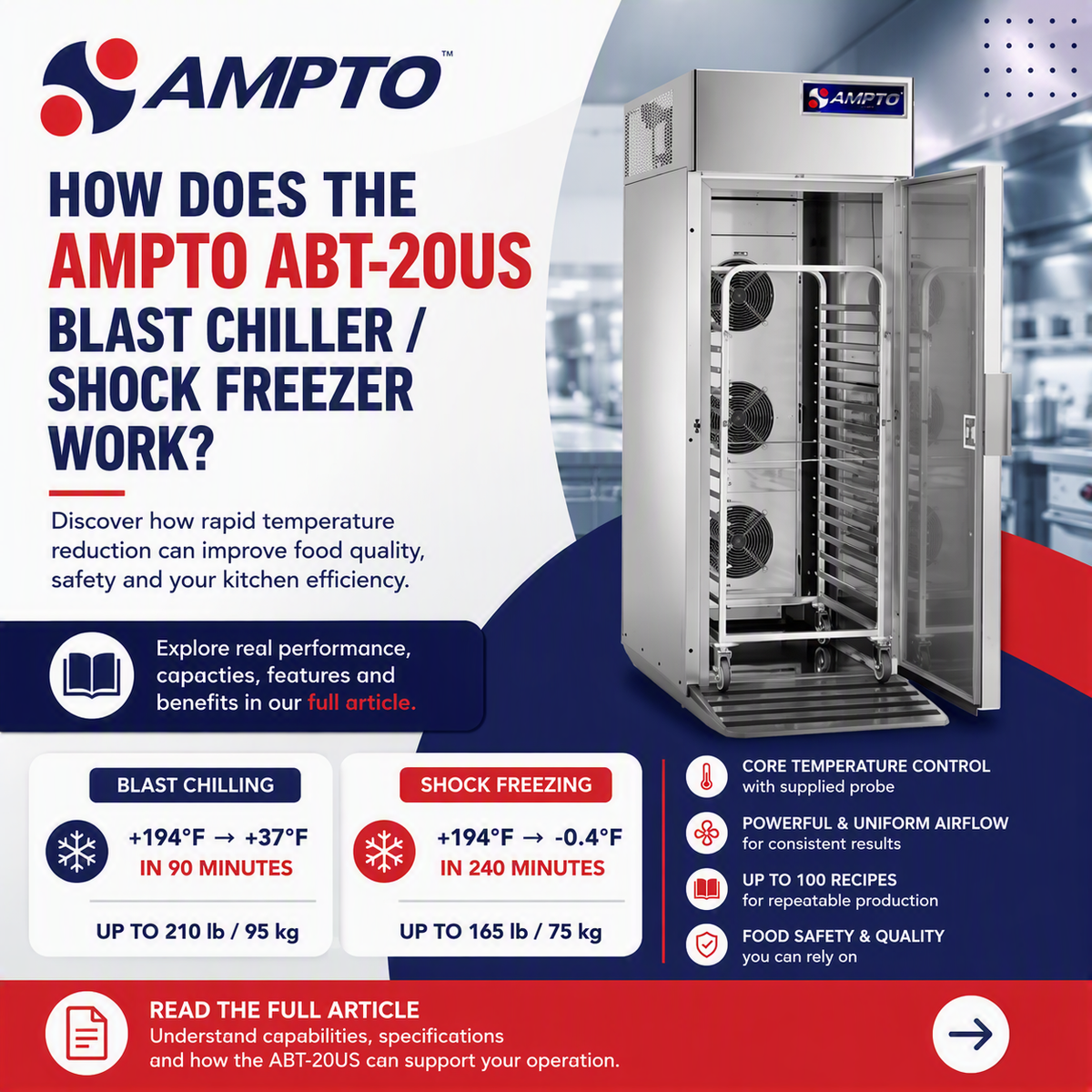
Blast Chilling: From +194°F to +37°F in 90 Minutes
In a blast chilling cycle, the ABT-20US is designed to reduce the core temperature of the product from approximately:
+194°F to +37°F (+90°C to +3°C) in 90 minutes.
The rated maximum load for this cycle is:
210 lb / 95 kg per cycle
In practical terms, if the machine is loaded with 210 lb of product entering at +194°F, the system is designed to bring the product's core temperature down to approximately +37°F within 90 minutes, under the specified test conditions.
This rapid temperature reduction allows an operation to move cooked products into controlled refrigerated storage much faster than conventional cooling methods.
The supplied core probe allows the cycle to be controlled according to the actual internal temperature of the food rather than relying exclusively on elapsed time.

Shock Freezing: From +194°F to -0.4°F in 240 Minutes
Shock freezing takes the process significantly further.
The ABT-20US is designed to take the core temperature of the product from approximately:
+194°F to -0.4°F (+90°C to -18°C) in 240 minutes.
Its rated maximum load for this process is:
165 lb / 75 kg per cycle
Therefore, when 165 lb of product enters at approximately +194°F, the unit is rated to reduce the product's core temperature to approximately-0.4°F within 240 minutes under the specified testing conditions.
During the freezing program, chamber air temperature can reach-40°F, while the target product temperature is -0.4°F.
That distinction is important:
The chamber air temperature and the product core temperature are not the same measurement.
The equipment uses very low-temperature, high-velocity refrigerated air to extract heat from the food until the desired core temperature is achieved.
What Does “210 lb Chilling Capacity” Really Mean?
This is an important specification for consultants and equipment buyers to understand.
A 210 lb chilling rating does not simply describe how much food physically fits inside the cabinet.
It describes a performance capacity.
According to the manufacturer's data, the equipment has a rated yield of:
| Process | Starting Core Temp. | Final Core Temp. | Rated Load | Cycle |
|---|---|---|---|---|
| Blast Chilling | +194°F / +90°C | +37°F / +3°C | 210 lb / 95 kg | 90 min |
| Shock Freezing | +194°F / +90°C | -0.4°F / -18°C | 165 lb / 75 kg | 240 min |
The technical documentation specifies these yields using a loading sample according to EN 17032:2018, at an ambient temperature of 86°F
Actual processing conditions matter
Real-world cycle performance can vary depending on factors such as:
- product entering temperature,
- individual product size and thickness,
- total load weight,
- product characteristics,
- and how the load is distributed.
This is why specifying a blast chiller only according to cabinet dimensions can be misleading.
The production load and desired processing time should be part of the equipment-selection conversation.
Designed Around a Full Trolley Workflow
The ABT-20US is configured to accommodate one GN 2/1 trolley or one 23.6 × 31.5-inch trolley.
For higher-volume kitchens, this trolley-based design can simplify the transition between production and chilling because products can remain organized on the trolley during processing.
The interior is constructed in AISI 304 stainless steel, including a reinforced insulated anti-slip floor with an entrance ramp and internal bumpers for trolley positioning.
This makes the ABT-20US particularly relevant when evaluating equipment for medium- to large-scale production environments.
Not Just Cold Air: Controlled Airflow Matters
The refrigeration system is designed around a vertical, multicircuit evaporator with a high heat-exchange coefficient.
The evaporator is equipped with three fans, and air speed can be varied through the controller. The technical documentation states that the airflow system is designed to provide uniform cooling across the product loaded on the trolley while helping avoid food dehydration.
Other operational details include:
- hot-gas defrost,
- automatic fan stop when the door opens,
- accessible evaporator walls for cleaning and maintenance,
- core-temperature needle probe,
- variable ventilation control.
For a consultant, these characteristics matter because blast chilling performance depends not only on refrigeration capacity, but also on how effectively refrigerated air reaches the product being processed.
Intelligent Cycle Control
The ABT-20US incorporates a 7-inch touchscreen interface and allows blast chilling to be managed either by time or by the core probe inserted into the product.
Available programs include:
- Chilling
- Hard Chilling
- Freezing
- Soft Freezing
The operator can also customize parameters including time, ventilation level and chamber temperature. A custom blast chilling program can be divided into as many as four distinct phases based on time, chamber temperature, product temperature and ventilation.
Up to 100 Recipes for Repeatable Production
One particularly useful capability for production kitchens is the integrated recipe book.
The control system can store up to 100 recipes, allowing operators to create and save customized cycles for different foods.
The system also provides:
- automatic storage at the end of a cycle,
- continuous diagnostics,
- real-time alarm display and logging,
- recipe upload and download,
- operating history export in Excel and CSV formats,
- parameterization and machine updates.
For operations processing multiple products throughout the week, programmable cycles can help establish a more standardized production method instead of requiring the operator to configure the machine from scratch for every load.
More Than Chilling and Freezing
The ABT-20US also includes dedicated special cycles for:
- Pre-cooling
- Ice cream hardening
- Drying
- Fish sanitization
- Bottle cooling
This gives consultants and operators the opportunity to consider the unit as a multi-purpose production tool, rather than evaluating the investment exclusively around conventional blast chilling.
Key Specifications at a Glance
| Specification | AMPTO ABT-20US |
|---|---|
| Blast chilling performance | 210 lb: +194°F → +37°F / 90 min |
| Shock freezing performance | 165 lb: +194°F → -0.4°F / 240 min |
| Trolley capacity | 1 GN 2/1 or 23.6 × 31.5 in |
| Exterior dimensions | 35 × 66 × 95 in |
| Interior dimensions | 27.9 × 52.7 × 73.6 in |
| Refrigerant | R290 |
| Control | 7" touchscreen |
| Core probe | Standard |
| Ventilation | Variable control |
| Defrost | Hot gas |
| Maximum absorbed power | 5,000 W* |
| Electrical supply |
3 × 220V ~ 60Hz |
For Consultants: Think in Pounds per Cycle, Not Just Cabinet Size
When specifying a blast chiller, the question should not simply be:
“What size machine fits the space?”
A better conversation starts with:
“How much hot product must this kitchen process during each production cycle, and what final temperature does the operation need to achieve?”
If an operation needs to blast chill approximately 210 lb per cycle, the ABT-20US provides a clear rated performance benchmark: +194°F to +37°F in 90 minutes.
If the objective is shock freezing, the corresponding rated capacity is 165 lb per cycle, from +194°F to -0.4°F in 240 minutes.
Those numbers make it easier to evaluate equipment based on production requirements rather than physical dimensions alone.
Is the AMPTO ABT-20US the Right Fit for Your Operation?
For catering operations, commissaries, bakeries, pastry production facilities and professional kitchens handling substantial batch production, blast chilling can become an important part of the production workflow.
The AMPTO ABT-20US combines high-capacity blast chilling and shock freezing with trolley loading, core-temperature control, variable airflow and programmable production cycles.
The next step is not simply choosing a machine.
It is properly sizing the machine to your production.
If you're a foodservice consultant designing a project, an operator evaluating production capacity, or a decision-maker planning an equipment investment, AMPTO can help evaluate the expected product type, entering temperature, batch weight and required final temperature to determine whether the ABT-20US is the appropriate solution.
Talk to AMPTO about your production requirements and let us help you size the blast chilling solution around the food you actually produce.